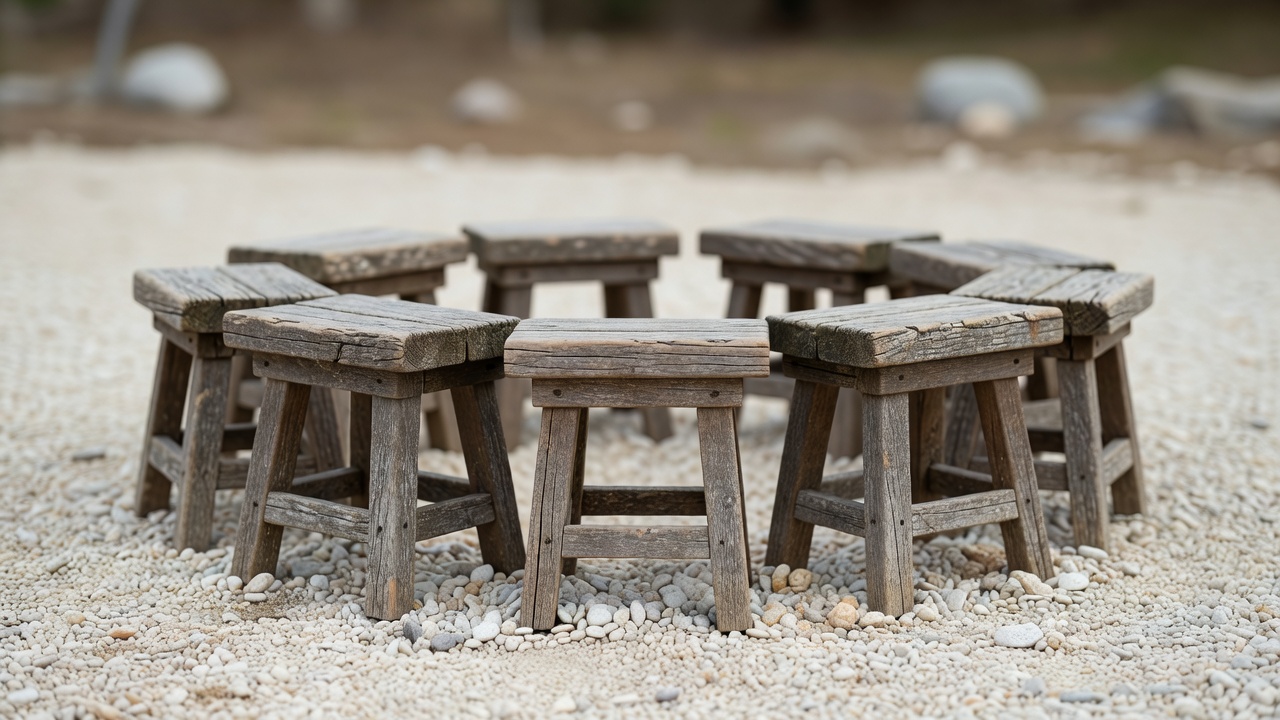
Why a circle works outdoors
Rhythm groups settle into circles for a simple reason: every player can see every pair of hands. Facilitators such as Arthur Hull, whose book Drum Circle Spirit shaped community drumming in the 1990s, built their whole approach around that shared view. In a garden the circle also does something practical. It turns the sound inward, so players hear each other clearly at a lower volume, and it gives you one compact footprint to shade, surface and screen.
You do not need a perfect ring. An oval, a horseshoe open towards the house or a half circle against a hedge all work. What matters is that no player sits with their back to another and that nobody is more than about four metres from the opposite side.
Sizing by player, not by patio
Start with a number: how many people usually play? A seated hand drummer with a djembe between the knees needs roughly 90 cm of arc. Multiply that by your group and you have the circumference of the seat line. From there the diameter is easy.
| Players | Seat-line diameter | With 90 cm walkway | Typical footprint |
|---|---|---|---|
| 4–5 | 1.3–1.5 m | 3.1–3.3 m | Small patio corner |
| 7–8 | 2.3–2.6 m | 4.1–4.4 m | Average lawn or terrace |
| 12 | 3.4–3.6 m | 5.2–5.4 m | Large lawn, needs wide shade |
| 16+ | 4.6 m and up | 6.4 m and up | Consider a double ring |
Mark the seat line with a length of rope pegged at the centre, then walk the outer walkway with a wheelbarrow or a pushchair. If either catches on a bed edge, the walkway is too narrow.
A seating diagram you can copy
Access is part of the layout
Treat accessibility as a measurement, not an afterthought. The US ADA Standards for Accessible Design set 36 inches (about 91 cm) as the minimum clear width for an accessible route and a 60-inch (about 1.5 m) circle for a wheelchair to turn. They are not law in a private garden, but they are excellent working numbers. Leave at least one open bay in the seat line, keep the path firm and step-free, and offer a couple of chairs with arms for people who need help standing up.
Choosing the ground
Lawn is soft and quiet but uneven, and stool legs sink after rain. Self-binding gravel compacts well and drains quickly. Paving and decking give a stable, level base and reflect more sound, which can make a small group feel louder than it is. A practical compromise is a level paved or decked pad for the circle itself, with planting and gravel around it to absorb and scatter sound.
Sightlines and orientation
Sit in each seat at the time of day you plan to play. Nobody should face straight into a low sun, and the facilitator seat should see the entry. Where possible, put the hardest surface, such as a house wall or fence, behind the group rather than in front, so reflections bounce back towards players instead of out across neighbouring gardens. Our shade guide covers the sun path in more detail.
Keep it reversible
Run the circle as a temporary layout for a full season before committing to benches, edging or concrete. Pegged rope, movable stools and a roll-out outdoor rug let you test group size, noise and comfort. If the space works, you will know exactly where to build. If it does not, the lawn recovers in weeks.
Setup checklist
- Group size counted and seat line marked with pegged rope
- Outer walkway of 90 cm tested with a barrow or pushchair
- One open bay and two armchairs in the arc
- Ground level checked with a spirit level and long board
- Each seat tested for sun glare at playing time
- Hard surfaces behind players, planting towards neighbours
- Store and water within a short, step-free walk